Edward and Florence's marriage and love relationship
On Chesil BeachEdward Mayhew and Florence Ponting’s marriage and love relationship is marked by a painful divide between the future they imagine together and their inability to speak clearly at a moment of crisis. Their affection is real, and each glimpses a possible life shaped by the other; yet on their wedding night, Florence’s attempt to express what she needs is interrupted, and Edward’s injured silence prevents reconciliation. Their separation becomes the decisive turning point in both lives, but especially in Edward’s later understanding of what he failed to do.
Courtship and a Shared Future
Before their marriage, the relationship holds room for curiosity, admiration, and the ordinary making of shared plans. Florence speaks of the Ennismore Quartet as the life she wants: after playing Beethoven’s Razumovsky for her former college tutor, the musicians are urged to remain together and work hard. She explains that quartet playing demands intense concentration, with each player acting as a soloist, and that returning to a piece reveals something new. She does not want to settle for a less demanding musical life if she can pursue the quartet’s ambitions.
Edward cannot initially share her understanding of classical music. He tends to hear it as a continuous, indistinct background sound, but he wants to understand Florence at work and accompanies her to a rehearsal. As the musicians repeat Mozart’s quintet, he gradually notices its melody and the changing interplay between the players. His response is not a conversion into the same kind of musician or listener; it is a small but consequential act of attention. On the train home he tells Florence honestly that the music moved him, and she promises that the quintet will be played for him when the Ennismore Quartet makes its debut at Wigmore Hall.
Their visions of the future also include a family. During the rehearsal, Edward imagines marriage and a daughter who might play an instrument. The thought reveals how readily he can picture a life with Florence, even as their respective ambitions and interests remain distinct. The relationship is not founded on identical tastes: its promise lies instead in the possibility that each could make space for what matters to the other.
Florence’s Unspoken Proposal
On the wedding night, Florence’s musical memory gives form to a choice she is struggling to make. She recalls the opening of a Mozart quintet: a cello phrase that repeatedly poses a question and receives uncertain answers from the other instruments. The passage belongs to a work she had insisted the Ennismore Quartet include, despite the complication of bringing in another viola player. Her decision had prevailed over the reservations of the other musicians, one against three. The memory reminds her that she is capable of stating and defending her own judgment.
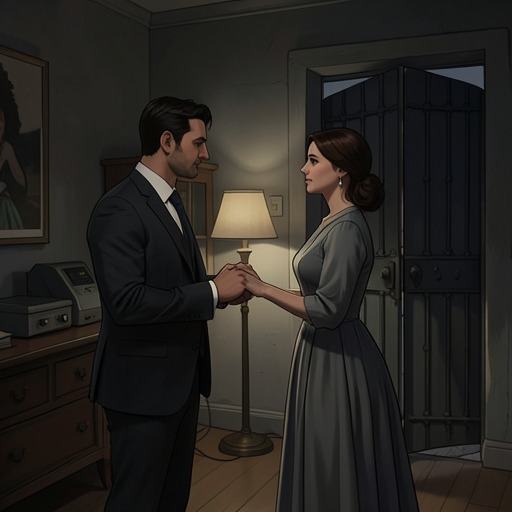
Florence briefly applies that resolve to her marriage. She understands that she does not have to submit silently to conventional expectations and intends to tell Edward what she does and does not want. She hopes they can find a compromise that does not require either person’s wishes to come at the other’s expense. In her mind, love should allow both of them freedom, and she has begun to form a proposal that might make a shared future possible. This is a moment of potential communication, not a settled agreement: when Edward approaches, her intention disappears before she can speak.
The contrast is central to the relationship’s collapse. Florence’s musical life gives her a model for taking initiative, yet the circumstances of the night unsettle her ability to carry that resolve into conversation with Edward. Her thoughts of compromise do not reach him. The possibility of negotiating their expectations remains private, while the two are left to interpret each other through hesitation and action rather than an exchange of what they need.
The Rupture and Immediate Aftermath
After Florence leaves him on the beach, Edward stays behind and dwells on the wrong he believes she has done him. He turns the encounter over repeatedly in his mind, imagining himself as the injured party and directing anger at her in his thoughts and actions. His account of the night becomes a closed circuit: he concentrates on the humiliation he feels, rather than asking what Florence’s departure might mean or following her. He does not call after her.
When Edward returns to the hotel, Florence has packed and gone. He learns from the hotel staff that she was urgently called home because of a family illness; the assistant manager has driven her to Dorchester so she can try to catch a train towards Oxford. Edward spends the rest of the night in the honeymoon suite, still absorbed in his grievance. At dawn he eats the food left in the room, drives Violet Ponting’s car back to the Ponting home, and leaves it there with the keys in the ignition. He then travels by train and walks home, avoiding the route Florence had taken the previous year. He refuses to explain himself to his father and makes his sisters promise not to mention Florence.
The practical end of the marriage follows quickly. A week later, Edward learns that Lionel Mayhew and Violet Ponting have quietly arranged a divorce on the grounds of non-consummation. At his father’s prompting, he sends Geoffrey Ponting a formal letter expressing regret, apologizing, resigning, and taking leave without mentioning Florence. The legal and family arrangements supply an orderly conclusion to a relationship whose central failure was that the couple did not reach an understanding together.
Separate Lives and a Deferred Understanding
For about a year, Edward remains too proud to seek Florence out or write to her. Because he hears nothing from her, he becomes convinced she must be with someone else. His later life moves away from the scholarly ambitions he once discussed with her. In London, amid the new freedoms and changing fashions of the late 1960s, he becomes more experienced in relationships and has numerous affairs; he also travels in France with a woman who becomes his wife for three and a half years. He never tells anyone about the wedding night.
Edward does not hear of the Ennismore Quartet’s successful debut at Wigmore Hall in July 1968. The review praises the performance and singles out Florence’s playing, describing the first violinist’s expressive work. As the musicians acknowledge the audience’s applause, Florence’s gaze travels to seat 9C in the third row—the place Edward had promised to occupy for her performance. The detail keeps their former promise present within her professional triumph, without suggesting that the relationship resumes or that Edward knows she has looked for him.
In later years, Edward repeatedly imagines explaining his life to Florence, but he does not contact her. His material circumstances and activities accumulate: he owns a small flat in Camden Town, a share of a cottage in the Auvergne, and two specialist record shops. He becomes godfather to five children, though he takes a more active role only as they grow older. After his father’s death, he remains in the family cottage and eventually lives there alone. These details sharpen his sense that his life has been comfortable but unambitious, and that he has never found another person whose seriousness matched Florence’s.
Retrospective Meaning
In his sixties, Edward’s walks through the countryside bring Florence back to him in specific places. At a fork in a beech wood he imagines the point where she may have paused over her map on the morning she came looking for him; overlooking the Stonor valley, he wonders whether it was where she stopped to eat an orange. The landscape gives his memory recurring points of return, while the years make clear that he has never stopped measuring his life against the one they might have shared.
Edward eventually understands Florence’s proposal differently. What once seemed to him absurd or insulting now appears generous and ahead of its time. He thinks that reassurance and patience might have enabled them to face their difficulties, and imagines the children they might have had. This recognition does not change the past, and it does not become a gesture of reconciliation: he still does not call or go after her. The decisive counterfactual remains that, on the beach, Florence would have turned back if she had heard his voice. Edward’s failure to speak is therefore not simply a moment of anger but the action—or inaction—that fixes the course of the relationship. His later love and regret persist alongside the knowledge that he had an opportunity to respond, and let it pass.